Short animated storytelling: designing science-based global health messages for extreme scalability
Distill health recommendations into simple, actionable behaviors
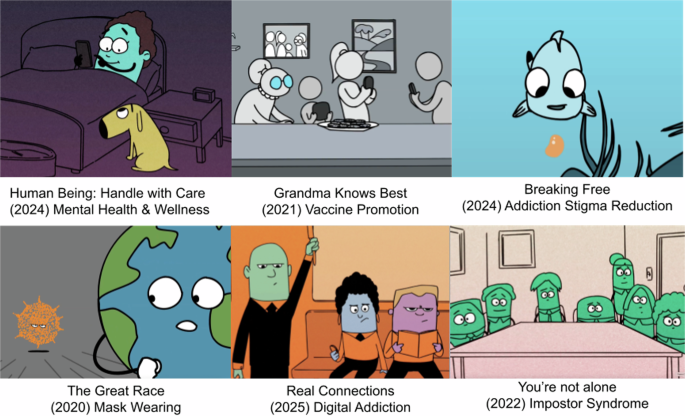
Health messages often fail not because of weak evidence, but because they are communicated in ways that are inaccessible to the populations that need them most. Physicians and public health practitioners may default to technical explanations that are difficult to remember or act upon. Our trials show that when recommendations are translated into simple, visually demonstrated actions, they are more likely to be watched and adopted8,9. For example, a 2-min animated video that showed a parent cooking healthy food with their child, increased behavioral intent among participants to reduce their consumption of added sugars9.
This principle echoes longstanding communication theory16 (“show, don’t tell”) but takes on new significance in the digital era, when short video media consumption has increased1,3. Wordless animation allows health behaviors to be incorporated into engaging narratives17,18 and demonstrated without reliance on language, crossing barriers of literacy and education. Looking ahead, generative AI tools could help automatically transform clinical guidelines into simplified, visual formats, lowering the barrier for medical experts to create accessible messages.
Meet people where they consume information—on social media
Since the COVID-29 pandemic, digital platforms such as YouTube, TikTok, Instagram, and Twitter/X have become central sources of health information for millions worldwide3,5. While misinformation has exploited these channels in ways that undermine health1, our research demonstrates that evidence-based messages can also achieve wide reach: the first “CoVideo” animation reached over 15 million views within 4 months8.
We acknowledge, however, that much of this early traction stemmed from amplification by Stanford Medicine’s institutional channels and subsequent uptake by major global health organizations. This visibility cannot be easily replicated by all public health teams. Thus, while our design principles are broadly transferable, achieving similar reach often requires partnerships with trusted institutions, influencers, or communities19. Future work should explore strategies—such as leveraging micro-influencers, community ambassadors, or algorithm-informed targeting20—that can help less-recognized teams and organizations achieve visibility.
Collaborate across areas of expertise
Effective digital storytelling emerges from interdisciplinary collaboration. In our projects, lived-experience experts worked alongside trained storytellers, animators, sound designers, behavioral scientists, and clinicians. This diversity of perspectives helped avoid blind spots and enriched the resulting stories. For instance, when developing an animated video aimed at reducing stigma towards vulnerable youth, incorporating the narratives of parents and children at high risk for facing stigma shaped both narrative authenticity and emotional resonance, improving the efficacy of the resulting intervention6.
Collaboration also extends beyond content design to dissemination. Social media strategists, marketing specialists, and data scientists can offer insights on how best to seed and track interventions21,22. In the future, partnerships with technologists will be increasingly important for leveraging AI tools, personalization algorithms, and adaptive media formats. Such collaborations not only strengthen the interventions themselves but also enhance scalability and sustainability.
Lead with compelling, emotionally resonant storytelling
Human cognition is structured around stories, which help people organize and retain information23. Embedding health recommendations within narratives stimulates curiosity, elicits emotion, and encourages sharing. In our trials, story-based animations outperformed purely informational ones on measures of engagement and intention18. This aligns with evidence from communication science on virality: content that evokes high-arousal emotions—such as awe or surprise—is more likely to spread20.
What distinguishes short, animated, wordless storytelling from traditional narrative approaches is its universality. By eliminating spoken language and cultural identifiers, a single story can resonate across contexts. Moreover, animated formats allow for creative metaphor and humor, in ways that live-action often cannot24. The convergence of visual narrative, universal story structure and human-centered design offers fertile ground for innovation that can boost patient satisfaction14. Future research should explore how these traditions interact to produce synergistic effects.
Figure 2 shows the “beats” of a story, following classical 3-act story structure, with corresponding examples from our short, animated mental health video “Human Being: Handle with Care” (2024).

Story beats with corresponding examples for a short, animated storytelling intervention aimed at promoting mental health and wellness.
The video referenced in Fig. 2 can be accessed via the link in Supplementary Table 1.
Design for inclusivity and durability from the outset
Messages designed to cross languages, education levels and cultures scale readily. We found that audiences responded positively to characters intentionally designed without specific cultural markers, enabling broad identification21. Similarly, health recommendations that are “evergreen”—such as handwashing or balanced nutrition—retain value over time, minimizing the need for repeated revisions22.
This principle also has equity implications. Populations with lower literacy or language access barriers are often excluded by text-heavy messaging. Visual, wordless stories can lower these barriers and democratize access to critical health information. In the future, AI-enabled translation and personalization tools may allow interventions to adapt in real-time. For example, our team has collaborated with local South African AI educational technology developers to create a multi-lingual AI virtual assistant trained to support South African community health workers in the field (philanimentor.com). The virtual assistant will soon be able to integrate short, animated storytelling videos. Such innovations could extend the life span and inclusivity of interventions beyond what manual tailoring allows.
Test and iterate rapidly—while complementing online randomized controlled trials with real-world experimentation
Randomized controlled trials remain the gold standard for evaluating interventions, and online platforms, like Prolific, have allowed us to test short, animated storytelling prototypes quickly, across diverse populations. Outcomes studied have included knowledge, stigma reduction and increased intention to adopt recommended behaviors, among others. These results can then be disseminated through peer-reviewed publications, offering transparency and replication potential6,8,9,10,25.
Trial participants who sign up on academic research platforms like Prolific are willing volunteers, not necessarily representative of the general population on social media. We therefore interpret these results with caution. We also recommend a hybrid approach: pair online RCTs with A/B testing within live campaigns, natural experiments tracking organic spread, and analytics-based monitoring of spontaneous engagement. This combined strategy ensures both rigor and ecological validity.
Looking ahead, AI-driven analytics and adaptive trial designs could enable real-time optimization of messages, automatically testing variants and tailoring content to audience segments. By embracing both controlled and ecological approaches, digital health storytellers can generate evidence that is not only scientifically robust but also practically relevant in fast-moving media environments.
link