Occupational health and safety employees and emerging competences in environmental field in mining and other sectors in Poland
Sustainable development points to the need for a broader view of occupational health and safety issues, including environmental and digital aspects. In the context of Polish and foreign formal conditions, this issue is significantly limited. Therefore, analysis of this issue seems crucial for a broader understanding. A review of the literature allows one to move from general policy factors to national solutions, prior evidence of competence, and international relevance.
OHS in the light of sustainable development
The long-term government program to improve safety and working conditions in Poland is a tool for implementing the provisions of the European Commission, including: in the EU strategic framework document on health and safety at work for 2021–202716, OSH in a changing world of work. The national program considers the objectives also set out in other important documents, such as Agenda 2030, and the European Green Deal, which correspond to environmental issues. Following principles that care for the environment and society has not become a fad, but a trend. In 2015, the 2030 Agenda for Sustainable Development presented 17 Sustainable Development Goals (SDGs) and 169 related tasks as a continuation of the Millennium Development Goals17. Among the goals and tasks, one can identify those whose implementation is related to OHS. OHS is primarily related to:
-
goal 3 Good health and well-being. Ensure healthy lives and promote well-being for all at all ages. 3.9 By 2030 substantially reduce the number of deaths and illnesses from hazardous chemicals and air, water, and soil pollution and contamination 3.a strengthen implementation of the Framework Convention on Tobacco Control in all countries as appropriate,
-
goal 8. Decent work and economic growth. Promote sustained, inclusive and sustainable economic growth, full and productive employment and decent work for all. 8.8 Protect labour rights and promote safe and secure working environments of all workers, including migrant workers, particularly women migrants, and those in precarious employment,
-
goal 16. Peace and justice. Promote peaceful and inclusive societies for sustainable development, provide access to justice for all and build effective, accountable and inclusive institutions at all levels 16.6 Develop effective, accountable and transparent institutions at all levels.
This statement is consistent with the position of the International Labour Organization (ILO)18, a tripartite UN agency that has been bringing together governments, employers and employees of 187 member states since 1919 to set labour standards, develop policies and programs promoting decent work for all women and men. In addition, ILO raises the issue of the Future of Work (FoW), emphasizing that work in a global perspective is undergoing transformation, resulting, among others, from technological progress, climate change, as well as demographic changes affecting the economy and employment. Based on data published by Cambridge University Press19, the Sustainable Development Goals (SDG) related to health and safety issues in Poland continue to face significant challenges (goal 3) and ongoing challenges (goal 8).
When describing the relationship between SD and OHS, it should be emphasized that these concepts should be treated together, considering their mutual influence. From the perspective of the enterprise, this approach promotes the company’s economic development. A safe and healthy employee is productive. On the other hand, high accident rates negatively affect the entity’s image and reduce demand for products and services20,21. However, it should be remembered that effectiveness in this area will not be ensured only by protection against common workplace hazards, but by a broader look at the implementation of SDG 3 through the development of management systems (workload) and stress minimization. Working on problem solving can ensure the implementation of the SD idea22. Milea et al.23 wrote about the positive impact of SDG implementation on accident rates and employee well-being. They also pointed to the challenges of coordinating sustainable activities in the context of OHS, including the lack of a unified framework for their implementation, limited organizational resources, and varying levels of awareness of SD issues. They also pointed to the need for research that takes into account industry and regional differences.
Incorporating and validating the implementation of sustainable development concepts in the workplace is a topic of scientific research. Moldovan et al.24describing the example of a healthcare facility, defined innovative indicators used to assess sustainability. The implemented solution contributed to improving the culture of sustainable development. Another example of SD being incorporated into company practices is the assessment of industries that have a significant impact on the environment25 or the identification of challenges related to the introduction of sustainable sectoral solutions26.
Another sustainable development goal related to OHS is SDG 4 Quality education. The importance of education on OHS is emphasized by Kavouras et al.27, encouraging the introduction of occupational safety issues into the curricula, primarily in engineering fields. This is justified because it has been confirmed that including OHS in university curricula contributes to reducing the accident rate28. Research was carried out29 on the assessment of the effectiveness of knowledge acquisition by Polish mine employees based on different training methods. It turned out that employee occupational health and safety competencies can be shaped by the appropriate selection of training methods. The computer methods of visualization and simulation aroused the greatest interest among recipients. Going further towards the implementation of SDG 4, it can be seen in education to increase the competencies of employees of OHS service.
Formal and legal conditions of the OHS service in Poland. OHS service in mining
The implementation of tasks in the field of occupational safety in Poland is described in legal regulations. The regulation of the Council of Ministers of September 2, 199730 on the OHS service specifies the scope of activities for the occupational health and safety service (§ 2.1).
The list includes 22 activities in the field of OHS of a control, information, analytical, development, documentation, regulatory, opinion-giving, advisory, training, organizational, consulting, commission or popularization nature. It should be emphasized that persons responsible for occupational safety cannot be burdened with any other tasks than those indicated in the law.
All tasks (22) can be performed by people who have appropriate competences acquired during vocational training or higher education. This is due to the great responsibility for creating safe working conditions aimed at protecting the health and life of employees. Moreover, in accordance with the Geological and Mining Law31, in order to perform the tasks of the OHS service in mining plants, such a person must have confirmed qualifications to perform these activities issued by the Director of the District Mining Office (art. 58). This requirement is justified by the specific threats to this business activity.
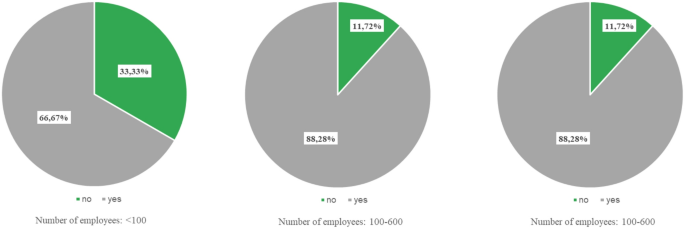
If more than 100 employees are employed, the employer is obliged to establish OHS Service, which employs an employee with appropriate competences to perform these tasks. For every 600 employees, the employer is obliged to employ one full-time OHS employee, while in the case of employing from 100 to 600 employees, the employer employs an employee for any full-time position. In the event of a decision by the controlling body – the Inspector at the State Labour Inspectorate – the employer may be obliged to increase the number or size of full-time positions. For enterprises with lower employment levels, the tasks are performed by the employer or the employer entrusts them to an external company (outsourcing) or an employee employed in other work30. This leaves some doubt about the time and personal possibilities of carrying out tasks in the field of occupational safety, because it is permanent.
The Regulation30 indicates the subordination of the OHS service employees and the positions in which persons perform tasks in the field of work safety. Generally, the OHS service reports directly to the highest management (employer, management board member), but in practice there are also solutions where the OHS service employees report to the OHS director, who is a direct subordinate of the employer. The OHS service employees are employed in the positions of inspector, senior inspector, specialist, senior specialist and chief specialist. The position for which an employee is employed depends on the stage of completed education and the length of professional experience30. Despite these legal regulations, in practice there are other job positions, e.g. the OHS assistant, etc. Importantly, in the mining industry, the positions defined in the law include the fact that the employee is an occupational supervisor in the OHS specialty and is directly subordinated to under the top management and indirectly under the mining plant operations manager, with whom he must cooperate closely31.
Competencies of OHS workers in research
Current research on the knowledge, skills and competences of the OHS service employees in national conditions was conducted, among others, by Lotko32. When analysing the learning outcomes of occupational health and safety studies, no issues related to environmental protection or sustainable development were identified, while at the same time emphasizing the role of lifelong learning and self-education in the profession. Dobrzyńska33 conducted survey research on the characteristics of the OHS service in Poland (structure of the service, conditions for entering the profession and professional advancement, conditions and form of employment in the OHS service, as well as sources of satisfaction and professional difficulties). Almost half of the surveyed OHS service representatives indicated improving qualifications as the most important factor in professional development. Sadłowska-Wrzesińska34 emphasized the development of social competences of the OHS specialist, emphasizing that the preparation of OHS specialists and their development should be broad-based in order to meet the new challenges of a changing work environment. The literature increasingly talks about green jobs35,36 and the greening of professions37. The European Working Conditions Telephone Survey36 shows that the ecological transition will have an impact on jobs, and new jobs will be created that may require improved skills. Policies designed for a green economy and sustainable development require deep awareness from many parties38. Considering the above research results do not identify previously coordinated education in the field of OHS and the subject of sustainable development or environmental protection and, on the other hand, existing and changing legal regulations and analyses confirming the impact of environmental issues and their importance in the functioning of companies, a research gap was identified on the Polish market. Moreover, the need to diagnose the requirements for occupational health and safety specialists and the duties they actually perform is consistent with the conclusions of international research39. While prior Polish studies (e.g., Lotko32, Dobrzyńska33 examined knowledge, skills and organisational characteristics of the OHS service, they did not explicitly address the integration of environmental competences into OHS roles nor propose a competence model aligned with sustainable development. This gap motivates our empirical analysis and the proposed model in the conclusions.
International context: integrating OSH and environmental competences in selected EU countries
The integration of occupational safety and health (OSH) with environmental management and sustainable development is increasingly visible across the EU policy landscape, notably in the EU Strategic Framework on OSH 2021–2027 and the Green Deal/Circular Economy agenda, which anticipate OSH implications of greener production systems and supply chains16. The integration problem has been discussed in international literature40. These EU-level directions call for competence development that spans traditional OSH and environmental domains.
In Czech Republik, OSH is primarily regulated through the Labour Code and Act No. 309/2006 Coll., which transposes EU directives and specifies additional OSH requirements such as workplace design, equipment and first aid. Although the legislation does not explicitly merge OSH and environmental roles, organisations often operationalise both through management systems and role-specific competences41,42.
In Germany, the OSH framework combines state and statutory accident insurance institutions under a dual system, with the Occupational Safety and Health Act (ArbSchG) requiring risk assessment, preventive measures and worker information. In practice, many German companies align OSH (ISO 45001) with environmental management (ISO 14001), emphasising competences that affect environmental performance and compliance13,16,43,44.
In the Netherlands, the Working Conditions Act (Arbowet) obliges employers to ensure safe and healthy work and to maintain a documented risk assessment (RI&E), while sectoral provides practical solutions and enforcement is carried out by the Netherlands Labour Authority. As in other EU countries, integration with environmental management systems is expanding in areas where risk and compliance intersect, such as dangerous substances, emissions and waste16,45,46.
Spanish national regulations on occupational health and safety do not explicitly refer to environmental protection47. However, the national health and safety strategy and programs48. identify key policy instruments for improving the effectiveness of the health and safety system by setting out the most important priorities and actions to improve the health and safety of workers. And although these priorities do not relate to environmental competences, they do point to the need to take climate and environmental change issues into account in OSH matters.
In Italy, it seems that combining occupational safety and environmental protection competencies is not practiced. As Colombo points out49, cooperation between health, safety, and environment specialists can be effective in operational decision-making. This changes the approach to shaping a broader awareness of combining these competencies. Nevertheless, trade unions, associations, and national policies should contribute to the transformation of HSE professionals’ competencies.
Taken together, these country snapshots show converging expectations: employers conduct systematic risk management, OSH professionals increasingly interact with environmental aspects and competence requirements are embedded in management systems. This EU-wide trend supports the focus on environmental competences within the OHS service13,16.
link