Job satisfaction as a mediator between organizational factors, work environment, and burnout among Jordanian midwives
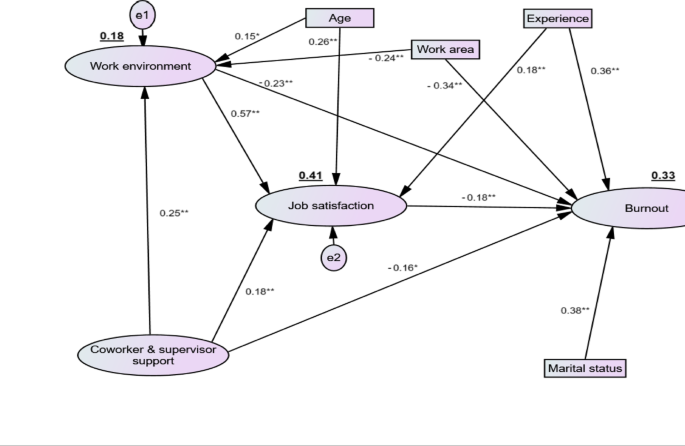
This study explores the relationship between the work environment, coworker and supervisor support, job satisfaction and burnout among midwives, with a focus on the mediating role of job satisfaction.
The results support the relevance of the JD-R model in a collectivist context, offering valuable insights into how organisational and individual factors affect midwives’ workplace outcomes. These factors directly influence job satisfaction, which subsequently impacts burnout levels, particularly within the collectivist cultural framework of Arab societies. These findings are essential for promoting midwives’ well-being and enhancing maternal and neonatal care. The data highlight that demographic factors and job resources, such as the work environment, are crucial determinants of job satisfaction, which mediates burnout levels.
The findings showed that demographics play a crucial role in shaping how individuals engage with their work environment and receive psychological and social support. Therefore, the alternative hypothesis (H₁), which posits that demographic factors (age, experience, marital status) significantly influence job resources (work environment and psychological/social support), was supported by the results in the SEM in Fig. 1.
The model shows a positive path coefficient (0.15) between age and work environment, indicating that older individuals tend to have a more favourable perception of their work environment. This may be attributed to senior healthcare workers having gained experience in developing resilience and coping mechanisms35. Our findings align with previous studies that suggested older and more experienced midwives report higher job satisfaction, as they can handle workplace challenges better and rely on long-established professional networks36. This is consistent with6, which found that Jordanian midwives aged 31–40 perceived their work environment negatively, affecting their ability to care for patients and increasing fatigue and burnout. Age appears to positively influence perceptions of job control and support, likely due to greater professional maturity and resilience. Sheehy et al. and Matthews et al. demonstrated similar findings36,37 , who similarly found that professional maturity and long-established support networks contribute to higher job satisfaction among midwives. However, our results also emphasize the cultural dimension: in Arab collectivist societies, seniority is often associated with social respect and stronger relational ties at work, amplifying the protective effect of age and experience against burnout7,17.
Conversely, a recent systematic review found that younger midwives are more likely to report burnout1. This may be due to higher expectations to perform at the same level as their more experienced colleagues, which can increase feelings of inadequacy and contribute to burnout1. These differing results suggest that the impact of age on job resources may vary depending on cultural and organisational contexts.
The results supported the second alternative hypothesis H₂: Work environment and psychological/support significantly influence job satisfaction. This was confirmed by the SEM, which showed that work resources, including the work environment and psychological support, have a significant impact on job satisfaction.
The model revealed a strong positive relationship (0.57) between the work environment and job satisfaction, consistent with recent findings1, who identified a significant link between supportive work environments and job satisfaction, highlighting that environments promoting autonomy, recognition and safety enhance satisfaction. While Albendín‐García et al. emphasised autonomy and recognition, the model presented here highlight the broader influence of the work environment1. Studies in Jordan also showed that poor work conditions in healthcare settings increase stress and reduce satisfaction, similar to the model’s findings5,6. These results are consistent across both collectivist and individualistic cultures, suggesting universal importance.
The model shows a positive relationship (0.18) between coworker/supervisor support and job satisfaction. This is consistent with Zadow et al. who found that psychological and social support from coworkers and supervisors significantly boosts job satisfaction, especially in high-stress fields like healthcare and education38. While coworker support has been found to have a stronger effect on satisfaction than supervisor support in previous studies1,4, the model does not distinguish between these roles, suggesting a broader, combined influence.
Furthermore, in collectivist societies, Huaman-Ramirez and Lahlouh, emphasised that coworker support is crucial due to the cultural emphasis on teamwork, which helps reduce both hierarchical and job content plateaus17.
Our study reinforces that job satisfaction acts as a buffer against burnout by enhancing emotional resilience. Albendín-García et al. also found that midwives with greater workplace autonomy and support experience lower emotional exhaustion1. This relationship is especially pronounced in collectivist cultures, where job satisfaction is deeply linked to social validation, teamwork, and the ability to meet communal expectations17,19. Therefore, burnout cannot be addressed solely through individual interventions, it requires system-level efforts that consider cultural context. These results align with the JD-R model, which views job satisfaction as a psychological resource that helps mitigate workplace stress and burnout38.
The SEM supports the third alternative hypothesis: H₃ (Job satisfaction mediates the relationship between work environment, psychological support and burnout), showing a statistically significant negative relationship (− 0.18) between job satisfaction and burnout. These results align with the JD-R model, which views job satisfaction as a psychological resource that helps mitigate workplace stress and burnout39. Similarly, previous research found that employees with higher job satisfaction are less prone to burnout, as satisfaction fosters emotional resilience and better stress management3. Additionally, research shows that workplace autonomy and recognition increase satisfaction and reduce emotional exhaustion1. However, the satisfaction–burnout relationship varies across contexts. In collectivist cultures, Huaman and colleagues emphasised the importance of relational factors like coworker and supervisor support in influencing satisfaction and burnout17, while in individualistic cultures, satisfaction is more strongly associated with personal growth and autonomy40. Contrasting findings suggest that the buffering effect of satisfaction lessens under high workload or unclear job roles, stressing the need for ongoing organisational support to sustain satisfaction over time41. These findings indicate that while job satisfaction is crucial in reducing burnout, other factors such as workload, role clarity and cultural differences should also be considered to fully understand the satisfaction–burnout relationship. This emphasises the need for interventions that improve job satisfaction while taking contextual and organisational factors into account.
The study supports the mediating role of job satisfaction in the relationship between job resources and burnout, aligning with previous research42. Job satisfaction helps reduce emotional exhaustion and disengagement by promoting a sense of purpose and achievement43 . For midwives, satisfaction often arises from positive workplace interactions and the ability to meet patient needs.
In Arab collectivist societies, job satisfaction goes beyond personal achievement, incorporating social approval and fulfilling communal expectations. Studies shows that healthcare professionals in collectivist cultures find identity and satisfaction in contributing to the well-being of their communities7. This further enhances the protective role of job satisfaction against burnout, highlighting its significance in designing effective workplace interventions.
Implications for Practice and Policy: These findings suggest that healthcare leaders should implement structured mentorship programs, especially for younger and less experienced midwives, and foster collaborative workplace cultures that reflect collectivist values. Regular peer support, fair workload distribution, and culturally tailored mental health services can improve job satisfaction and reduce burnout. From a policy standpoint, integrating organizational justice frameworks and continuous professional development programs focused on emotional resilience may promote workforce sustainability. These recommendations are especially relevant for health systems in the Arab region undergoing reform.
link